Phone Verification API Comparison: What to Look for Before You Integrate
PilotLookup Team
Author
In this article
- Why the "just pick one and try it" approach costs you later
- Dimension 1: Data accuracy and freshness
- Dimension 2: Response fields — what data you actually get
- Dimension 3: Latency and uptime
- Dimension 4: Pricing model and cost at scale
- Dimension 5: Privacy, compliance, and data retention
- Evaluation checklist
1. Why the "Just Pick One and Try It" Approach Costs You Later
Phone verification APIs look similar on the surface. They all accept a phone number, hit a carrier database, and return some JSON. Most have free trials. Most claim high accuracy. The temptation is to pick whichever one appears first in a search, get a working integration in an afternoon, and move on to the next task.
The problem with that approach becomes visible three to six months later, when you're investigating a spike in fraudulent signups that bypassed your VoIP filter, or debugging why your SMS campaigns have a lower-than-expected delivery rate despite pre-validation, or trying to explain to your finance team why your phone API bill doubled even though your signup volume was flat. At that point, migrating to a different provider means re-writing integration code, re-validating your existing data, and potentially re-tuning all the risk logic that downstream systems depend on.
Evaluating a phone verification API properly before integrating takes a few hours. Switching providers after you're deeply integrated takes weeks. This guide walks through the five dimensions that matter most and gives you a concrete evaluation checklist to apply to any provider you're considering.
2. Dimension 1: Data Accuracy and Freshness
The single most important property of a phone verification API is the accuracy of its underlying data. An API that returns stale or incorrect carrier assignments is worse than no validation at all, because it gives you false confidence. You'll make business decisions — routing SMS, scoring risk, approving accounts — on information that doesn't reflect reality.
Two things drive accuracy: the data source and the update frequency. For US phone numbers, the authoritative source is the NPAC (Number Portability Administration Center) — the national database that tracks carrier assignments after number porting. Providers that query NPAC directly and sync it at least daily will have accurate carrier data for ported numbers. Providers that use static numbering plan databases — a mapping of number prefixes to original carriers — will be wrong for any number that has been ported. In the US, where porting is common, that's a significant portion of mobile numbers.
When evaluating any phone verification API, ask directly: what is your data source for US carrier lookups? How frequently is it updated? What is your accuracy rate for ported numbers specifically? A provider confident in their data quality will answer these questions precisely. Vague answers like "we use multiple sources" are a yellow flag.
3. Dimension 2: Response Fields — What Data You Actually Get
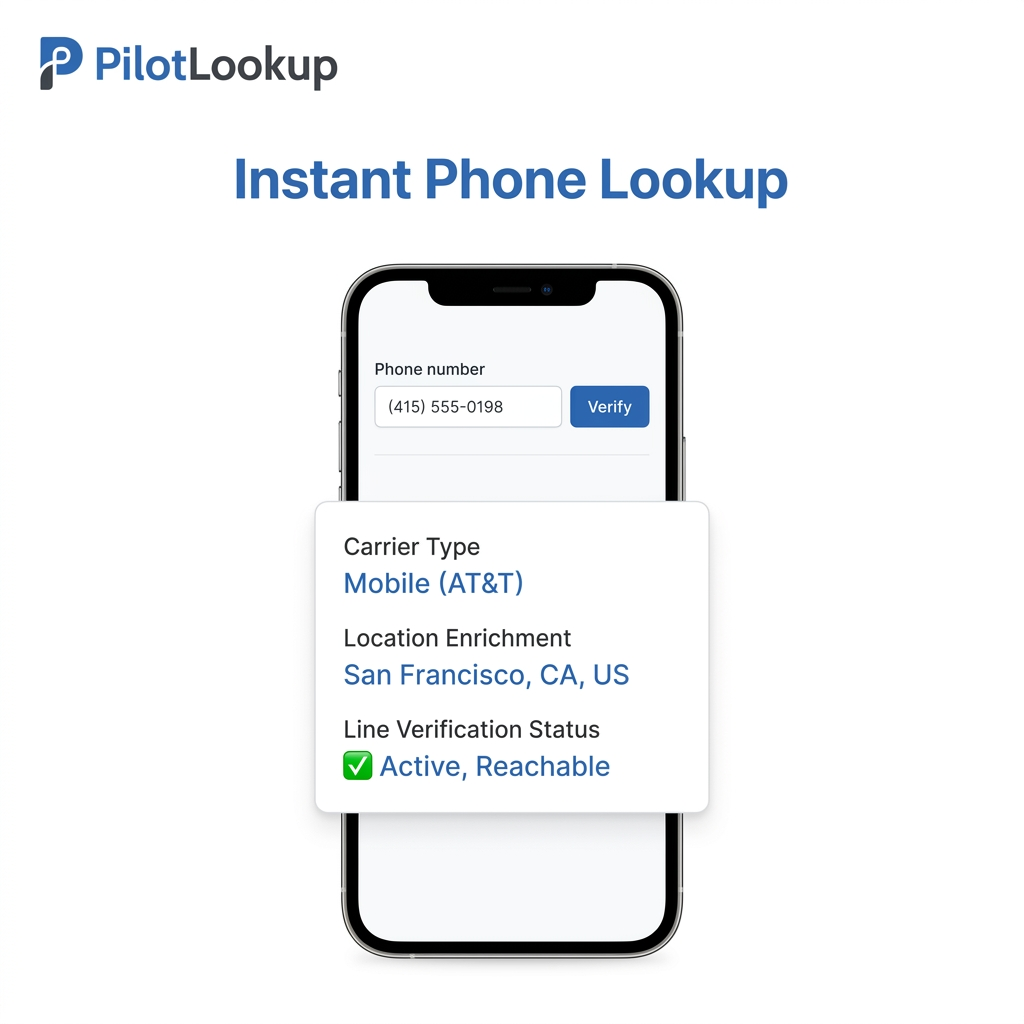
Phone verification APIs vary significantly in how much information they return per lookup. At minimum, a useful API should return: whether the number is valid and active, the current carrier name, the line type (mobile, landline, VoIP, or toll-free), and some geographic indicator (at minimum state, ideally city).
Line type is the field most commonly missing or inaccurate in budget-tier APIs. It's also the field that does the most work in fraud prevention and SMS routing decisions. An API that returns carrier name but not line type forces you to build your own carrier-to-line-type mapping — a fragile, maintenance-heavy approach that breaks every time a carrier adds a VoIP product or acquires another provider.
Beyond the basics, some APIs offer additional signals worth evaluating: recent porting activity (a number ported in the last 30 days is elevated fraud risk), number age (newer numbers are higher risk), and pre-computed risk scores. These extras are valuable but shouldn't substitute for the core fields being accurate.
| Field | Why it matters | Minimum acceptable |
|---|---|---|
valid |
Confirms the number is assigned to an active subscriber | Required |
carrier |
Current carrier name (post-porting) | Required |
line_type |
Mobile / landline / VoIP / toll-free — drives fraud and SMS logic | Required |
city / state |
Geographic context for the number | State at minimum |
| Recent port flag | Numbers ported recently are elevated fraud risk | Nice to have |
| Risk score | Pre-computed fraud signal aggregation | Nice to have |
4. Dimension 3: Latency and Uptime
A phone verification API called synchronously in a signup or checkout flow needs to respond fast enough to be invisible to the user. If validation adds 2–3 seconds to your form submission time, users will notice — and some will abandon. The practical threshold for synchronous use is under 300ms median response time; the best providers hit under 150ms.
Latency is usually a function of architecture. APIs running on edge infrastructure — CDN-distributed nodes close to your users — consistently outperform APIs running from a single data center. Ask providers where their infrastructure runs and whether they have nodes in the regions where your users are concentrated. A US-focused provider with US edge nodes will outperform a European-hosted provider on US number lookups, even if the European provider has technically faster servers in isolation.
Uptime matters differently. A phone verification API going down for 30 minutes doesn't mean you lose 30 minutes of signups — it means you have to decide, in real time, whether to fail open (allow signups without validation) or fail closed (reject all signups until the API recovers). Neither is great. Evaluate uptime SLA guarantees and check whether providers publish a status page with historical incident data. An SLA of 99.9% allows for about 8.7 hours of downtime per year; 99.99% allows for about 52 minutes.
5. Dimension 4: Pricing Model and Cost at Scale
Phone verification APIs price in two primary models: subscription (a fixed monthly fee for a certain number of lookups, often with overages) and credit-based pay-as-you-go (you buy a block of credits and use them at your own pace). Each model has different implications depending on your volume profile.
Subscription models favor predictable, high-volume use cases where you're confident you'll use most of your allocation every month. They tend to have lower per-lookup costs at the stated volume tier but penalize you if your usage is uneven — you pay for the full month even in a slow month, and overages can be expensive.
Credit-based models favor variable-volume use cases and early-stage products. You only pay for what you actually use, there are no overages, and you can buy credits in advance when pricing is favorable. The per-lookup cost is slightly higher at the same volume point, but the total cost is often lower because you're not paying for unused allocation.
When comparing pricing, always model the cost at your expected volume across a full year, including months where usage is lower than average. Factor in whether credits expire — a provider that expires credits in 90 days effectively forces a subscription model on you whether you want one or not.
6. Dimension 5: Privacy, Compliance, and Data Retention
Phone numbers are personal data. Every regulatory framework that covers personal data — GDPR, CCPA, HIPAA in healthcare contexts — has implications for how you handle phone numbers you collect and what you can do with them. Your phone verification API vendor is a data processor in your chain, and their data retention practices affect your compliance posture.
The critical question is: does the provider store the phone numbers you look up? Some providers log every query, including the phone number itself, for analytics, quality assurance, or to build derived datasets they sell separately. Others operate with a no-retention policy — the number is used to query the carrier database and then immediately discarded, with no log of which numbers were looked up.
For most applications, especially those in healthcare, finance, or serving EU users, a no-retention provider is the only acceptable choice. Verify this policy in the provider's privacy documentation and service agreement, not just in marketing copy. Ask specifically: do you log phone numbers submitted to your validation API? Do you use query data to build any secondary datasets? Can you provide documentation of your data retention policy for compliance review?
Also evaluate TLS version support (TLS 1.3 is the current standard; providers still on TLS 1.2 only are behind), whether they have SOC 2 compliance, and whether they can sign a Data Processing Agreement (DPA) if you need one for GDPR.
7. Evaluation Checklist
Run every provider you're evaluating through this checklist before making a decision:
| Criterion | Question to ask | Evaluated? |
|---|---|---|
| Data source | Does the provider use NPAC for US carrier data? | ☐ |
| Update frequency | How often is carrier data refreshed? | ☐ |
| Ported number accuracy | Did it correctly identify current carrier on known ported numbers? | ☐ |
| Line type coverage | Does the API return mobile / landline / VoIP / toll-free? | ☐ |
| Response latency | What is the median and p99 response time from your region? | ☐ |
| Uptime SLA | What is the guaranteed uptime and where is the status page? | ☐ |
| Pricing model | Is it subscription or pay-as-you-go? Do credits expire? | ☐ |
| Cost at your volume | What is the projected annual cost at your expected lookup volume? | ☐ |
| Data retention | Does the provider store phone numbers submitted to the API? | ☐ |
| Compliance | Is the provider SOC 2 compliant? Will they sign a DPA? | ☐ |
| Free trial | Can you test with real lookups before committing? | ☐ |
Test PilotLookup Against Your Checklist
10 free lookups — no credit card required. See the data quality for yourself before committing.
Start Free →Questions? support@pilotlookup.net · 1-888-370-6801