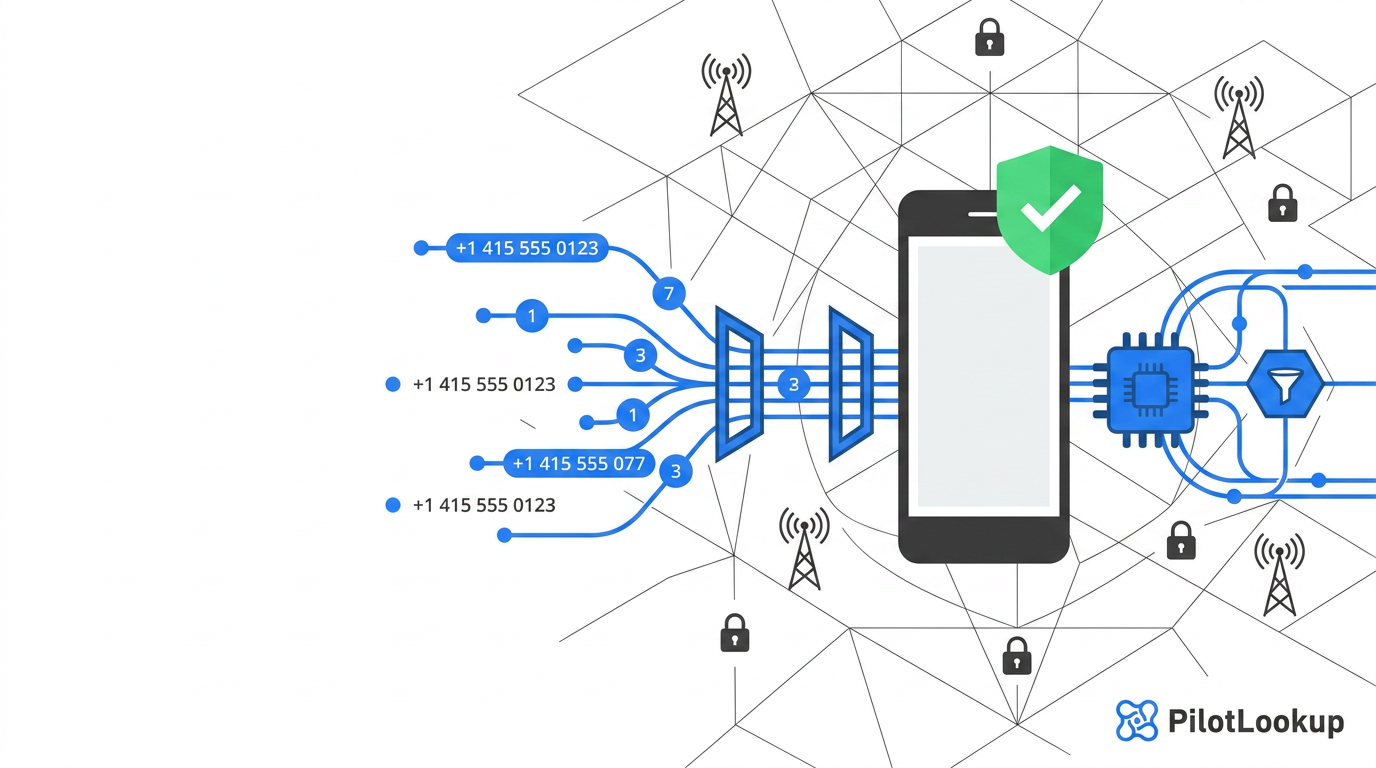
Phone Number Validation 101: How Real-Time Phone Verification Protects Your Business
PilotLookup Team
Author
Introduction
Every day, businesses collect thousands of phone numbers — from checkout forms, lead-gen pages, account signups, and customer service interactions. But here's the uncomfortable truth: a significant portion of those numbers are wrong. They might be typos, disconnected landlines, temporary VoIP numbers used to bypass identity checks, or outright fake entries designed to exploit your system.
According to industry research, up to 30% of contact data becomes inaccurate within 12 months. When businesses fail to validate phone numbers in real time, the consequences range from wasted SMS marketing budgets to full-blown fraud events that cost companies millions.
This guide will walk you through exactly what phone number validation is, how real-time phone verification works under the hood, and why it has become a non-negotiable safeguard for businesses of all sizes. We'll also walk through a real-world example of how a growing e-commerce company used validation to dramatically cut fraud and improve its customer experience.
What Is Phone Number Validation?
Phone number validation is the process of verifying that a phone number is correctly formatted, active, reachable, and associated with the type of line (mobile, landline, or VoIP) your business expects. It goes far beyond simply checking if ten digits have been entered in the right format.
True phone number validation involves several layers of checks:
Format verification — Is the number properly structured according to national and international dialing standards?
Carrier lookup — Which telecom carrier currently owns that number?
Line type detection — Is it a mobile, landline, VoIP, toll-free, or premium number?
Activity check — Is the number currently active and assigned to a subscriber?
Location data — What geographic region is associated with the number?
Each of these checks adds a layer of intelligence that allows your business to make smarter decisions about the phone numbers entering your system.
What Is Real-Time Phone Verification?
Real-time phone verification takes validation a step further. Instead of cleaning phone data in batches after collection, it happens at the moment of entry — typically via an API call that returns results in milliseconds.
This is critical because catching a bad number before it enters your database is infinitely more cost-effective than dealing with its downstream consequences. A real-time phone verification API like PilotLookup typically works in four steps:
Your user enters a phone number on a form or during checkout.
Your application sends a lightweight API request containing the number.
The API queries live carrier databases and returns structured data — carrier name, line type, location, and validity status.
Your application uses the response to either allow, flag, or block the submission within milliseconds.
The entire round trip typically takes under 150 milliseconds — fast enough to be completely invisible to the end user.
PilotLookup Fact
PilotLookup's real-time phone verification API returns results with a median response time of ~120ms, with 99.9% data accuracy. Developers can integrate it and go live in production within an afternoon.
Why Phone Number Validation Matters: The Hidden Costs of Bad Data
Before we look at how validation works technically, let's understand what's at stake when businesses skip it.
1. SMS and Voice Campaign Waste
SMS marketing delivers one of the highest ROI rates of any digital channel — but only when messages reach real, active numbers. When you send to disconnected numbers, landlines that can't receive texts, or VoIP numbers that are inactive, you pay per message sent, not per message delivered. At scale, this adds up fast.
2. Fraud and Account Abuse
Fraudsters routinely use temporary VoIP numbers, SIM farms, or stolen number pools to create fake accounts, claim sign-up bonuses, abuse free trial offers, and bypass two-factor authentication. Without line type detection and carrier validation, these numbers look identical to legitimate mobile numbers.
3. Compliance Risks
The Telephone Consumer Protection Act (TCPA) in the US requires businesses to maintain Do-Not-Call compliance and obtain proper consent. Sending messages to wrong numbers or reassigned numbers can trigger regulatory penalties. Accurate phone validation helps maintain a clean, compliant database.
4. Poor Customer Experience
When your support team calls a number on file and it's disconnected, or when a customer never receives their verification OTP because their number was entered incorrectly, you lose trust — and often, the customer.
Real-World Example: How ShopNova Cut Fraud by 40% with Real-Time Validation
ShopNova is a mid-sized online retailer selling consumer electronics, processing roughly 8,000 orders per month. In late 2023, the company began experiencing a surge in fraudulent orders — customers claiming items weren't delivered, chargebacks piling up, and promotional voucher abuse spiking.
The fraud team investigated and discovered a pattern: nearly all fraudulent orders were placed using VoIP phone numbers — virtual numbers that could be created instantly, used for one-time verification, and discarded. Their checkout form accepted any ten-digit number without checking whether it was a real mobile number tied to an actual person.
The Problem
ShopNova's existing checkout system did basic format validation — it checked that the number had ten digits and matched a US pattern. But it had no way of knowing whether the number was:
A mobile number tied to a real subscriber
A VoIP number from a virtual number provider
A disconnected or reassigned number
A number that had been flagged in fraud databases
The Solution
ShopNova integrated PilotLookup's phone validation API into their checkout flow. The integration took a single backend developer two hours to implement. Here's how it worked:
At checkout, when a customer entered their phone number, the form triggered an API call to PilotLookup.
The API returned the carrier name, line type (mobile, VoIP, landline), and validation status within 120ms.
ShopNova's checkout logic then applied rules: if the number was identified as VoIP, the order was flagged for manual review before processing.
Mobile numbers from major carriers passed through normally.
Disconnected or invalid numbers triggered an inline error message asking the customer to re-enter their number.
The Results
Within 30 days of going live with real-time phone verification:
Fraudulent orders dropped by 40%
Chargeback rates fell from 2.3% to 1.1%
SMS delivery rates on order confirmations improved from 84% to 96%
Customer support calls about undelivered OTPs dropped by 60%
The ROI was clear within the first billing cycle. The cost of API calls was a fraction of what ShopNova had been losing to fraud and failed deliveries.
Key Insight
ShopNova's story illustrates a core principle: phone number validation is not just a technical feature — it's a business risk management tool. The cost of validation is measured in fractions of a cent per lookup. The cost of not validating can be measured in percentage points of revenue.
How Real-Time Phone Verification Works: A Technical Overview
For developers and technical decision-makers, it's worth understanding what happens behind the scenes when you make a phone validation API call.
Step 1: Number Normalization
The API first normalizes the number — stripping formatting characters, resolving country codes, and converting it to E.164 international format. For example, (203) 214-5454 becomes +12032145454.
Step 2: HLR and Carrier Database Lookup
The API queries Home Location Register (HLR) data and live carrier databases to determine which telecom currently holds the number. This reveals whether the number is active, which carrier owns it, and whether it has been recently ported to a different carrier.
Step 3: Line Type Classification
Using carrier data combined with machine learning heuristics, the system classifies the line type: mobile, fixed landline, VoIP/virtual, toll-free, pager, or unknown. This classification is particularly valuable for fraud prevention because VoIP numbers are disproportionately associated with fraudulent signups.
Step 4: Response Delivery
The full enriched data object is returned to your application, typically as a JSON response. A sample response from PilotLookup looks like this:
{ "phone": "+12032145454", "valid": true, "carrier": "T-Mobile", "line_type": "mobile", "country": "US", "location": "Connecticut", "ported": false }Best Practices for Implementing Phone Validation
Here are the key best practices to get the most out of real-time phone verification:
Validate at the point of entry, not in batches. Real-time validation prevents bad data from ever entering your system.
Use line type data to set risk thresholds. Mobile numbers are generally lower risk; VoIP numbers warrant additional scrutiny.
Don't block VoIP numbers blindly. Some legitimate users, including international customers and remote workers, use VoIP services. Consider flagging rather than outright blocking.
Combine phone validation with other signals. Use it alongside email validation, IP geolocation, and behavioral analysis for stronger fraud prevention.
Keep your integration lightweight. A single API call per phone number submission adds negligible latency and zero friction for real users.
Conclusion
Phone number validation is one of the simplest, highest-ROI technical integrations a business can make. Real-time phone verification catches bad data before it causes problems, reduces fraud, improves SMS deliverability, and ensures your customer communications actually reach real people.
Whether you're running an e-commerce store, a SaaS platform, or an enterprise CRM, the question isn't whether you can afford to validate phone numbers — it's whether you can afford not to.
PilotLookup makes it easy to get started. With a free API key, 10 free lookups, and documentation clear enough to go live in an afternoon, there's no reason to leave your phone data unverified.
Start validating phone numbers today at www.pilotlookup.net