How to Validate US Phone Numbers in Your App: A Developer's Guide
PilotLookup Team
Author
In this guide
- Why US phone validation is harder than it looks
- US phone number format rules
- Layer 1: Format validation with regex
- Layer 2: Carrier and line-type lookup via API
- Code examples: Node.js, Python, PHP
- When in the request lifecycle to validate
- Recognizing fraud patterns with line-type data
- Bulk validation for CRM hygiene
- API credits and cost planning
- Implementation checklist
1. Why US Phone Validation Is Harder Than It Looks
Most developers' first instinct is to write a quick regex — ^\d{10}$ — and call it done. That catches obvious garbage like letters and symbols. But it tells you almost nothing useful. A number that passes a format check might be:
- Disconnected and unassigned
- A VoIP number created in seconds and disposable after use
- A valid landline that will never receive an SMS
- A number that has been ported to a different carrier since it was collected
- A toll-free number someone entered by mistake
Each of these cases has different implications depending on your use case. A fraud-prevention system cares deeply about VoIP vs. mobile. An SMS marketing platform cares about landlines that can't receive texts. A CRM cleanup job cares about disconnected numbers. Real US phone validation means handling all of these layers — not just shape-checking the string.
This guide is structured as a layered approach. You'll start with client-side format validation (cheap, instant, zero API calls), then add server-side carrier lookup (the layer that actually gives you signal). We'll cover every layer with production-ready code examples.
2. US Phone Number Format Rules
Before writing any validation code, it helps to understand the North American Numbering Plan (NANP) — the standard that governs US (and Canada/Caribbean) numbers. All US phone numbers follow a consistent structure:
| Part | Digits | Example | Constraints |
|---|---|---|---|
| Area Code (NPA) | 3 | 203 | First digit must be 2–9. Second digit was historically 0 or 1, but modern NPAs can be any digit. Cannot start with 0 or 1. |
| Central Office Code (NXX) | 3 | 214 | First digit must be 2–9. Cannot be 555-0100–555-0199 (reserved for fiction). N11 codes (211, 311, etc.) are service codes, not valid NXX. |
| Subscriber Number | 4 | 5454 | Any four digits. |
Users submit phone numbers in wildly inconsistent formats. Your validation code needs to handle all of these as equivalent inputs:
| Input format | Normalized E.164 | Valid? |
|---|---|---|
2032145454 | +12032145454 | ✓ |
(203) 214-5454 | +12032145454 | ✓ |
+1 203 214 5454 | +12032145454 | ✓ |
1-203-214-5454 | +12032145454 | ✓ |
203.214.5454 | +12032145454 | ✓ |
0002032145454 | — | ✗ (too many digits) |
1234567890 | — | ✗ (NPA starts with 1) |
5551234567 | — | ✗ (NPA starts with 5 — technically valid format but NXX 555-0100 range is fictional) |
3. Layer 1 — Format Validation with Regex
Client-side and server-side format validation is your first gate. It's free, instantaneous, and catches garbage input before it ever touches your database or API budget. Here's a production-ready approach for each common language.
The normalization pattern
The key insight: normalize first, validate second. Strip everything non-digit, handle the optional leading 1 country code, then apply NANP rules.
/**
 * Normalize and validate a US phone number.
 * Returns the E.164 string (+1XXXXXXXXXX) or null if invalid.
 */
function normalizeUSPhone(input) {
  // Strip everything except digits
  const digits = input.replace(/\D/g, '');

  // Handle optional leading country code
  let local = digits;
  if (digits.startsWith('1') && digits.length === 11) {
    local = digits.slice(1);
  }

  // Must be exactly 10 digits
  if (local.length !== 10) return null;

  const npa = local.slice(0, 3);   // area code
  const nxx = local.slice(3, 6);   // central office code

  // NANP: first digit of NPA and NXX must be 2–9
  if (/^[01]/.test(npa) || /^[01]/.test(nxx)) return null;

  // Reject N11 service codes as NXX (211, 311, 411, 511, 611, 711, 811, 911)
  if (/^[2-9]11$/.test(nxx)) return null;

  return `+1${local}`;
}

// Usage
console.log(normalizeUSPhone('(203) 214-5454'));   // +12032145454
console.log(normalizeUSPhone('1-800-555-0199'));   // +18005550199 (toll-free)
console.log(normalizeUSPhone('123-456-7890')); // null (NPA starts with 1)import re
def normalize_us_phone(raw: str) -> str | None:
"""
Normalize a US phone number to E.164 (+1XXXXXXXXXX).
Returns None if the number fails NANP format rules.
"""
digits = re.sub(r'\D', '', raw)
# Strip leading country code if present
if len(digits) == 11 and digits.startswith('1'):
digits = digits[1:]
if len(digits) != 10:
return None
npa, nxx = digits[:3], digits[3:6]
# NPA and NXX must start with 2–9
if npa[0] in ('0', '1') or nxx[0] in ('0', '1'):
return None
# Reject N11 service codes
if re.match(r'^[2-9]11$', nxx):
return None
return f'+1{digits}'
# Usage
print(normalize_us_phone('203.214.5454')) # +12032145454
print(normalize_us_phone('0123456789')) # None4. Layer 2 — Carrier and Line-Type Lookup via API
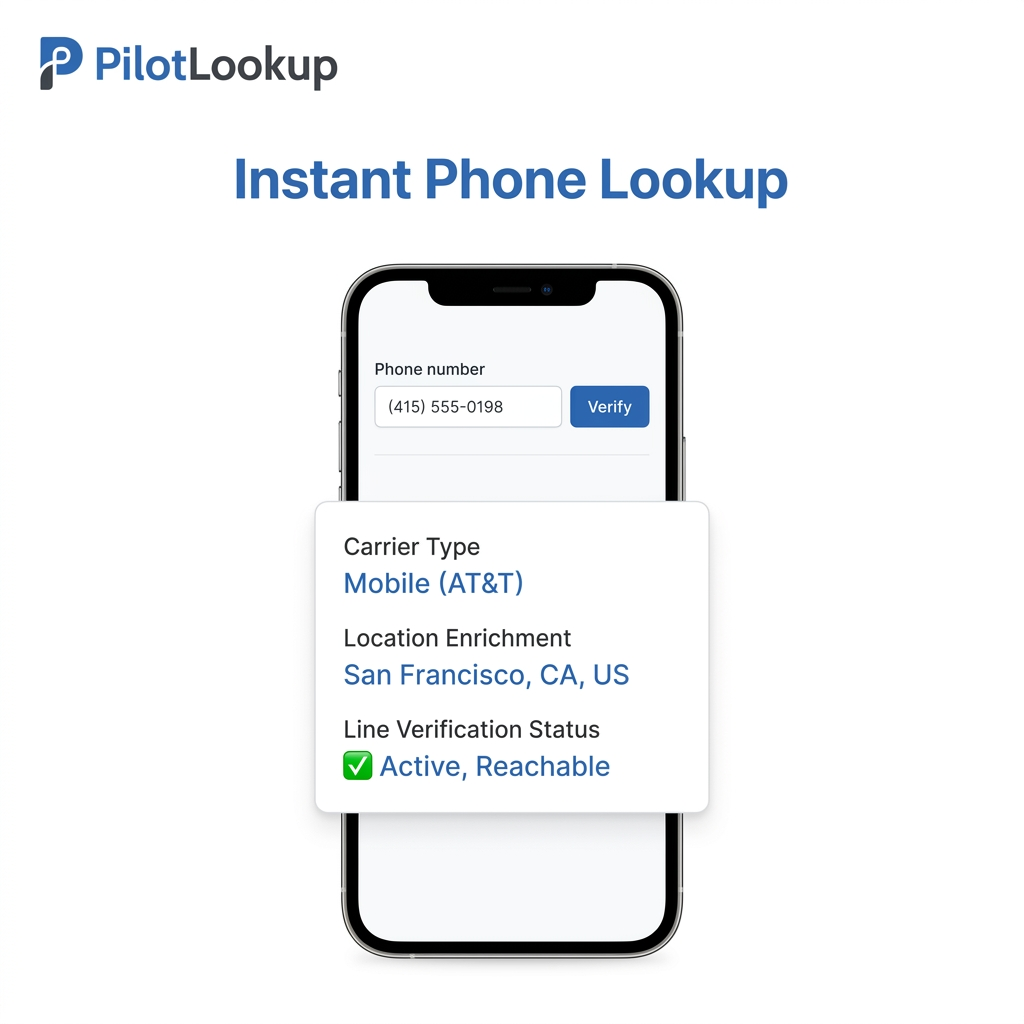
Once a number passes format validation, the second layer queries live carrier databases to answer three questions your app actually cares about:
- Is the number currently active? (assigned to a live subscriber)
- What carrier owns it right now? (accounting for number portability)
- What type of line is it? (mobile, landline, VoIP, toll-free)
This data comes from the Number Portability Administration Center (NPAC) — the authoritative database that tracks which carrier holds each US number after porting. A good phone validation API like PilotLookup queries NPAC daily to stay current, then returns the enriched data in a single REST call.
The PilotLookup API request
GET https://www.pilotlookup.net/api/validate?phone={number}
Authorization: Bearer YOUR_API_KEY
Example response
{
  "phone":     "+12032145454",
  "valid":     true,
  "carrier":   "T-Mobile",
  "line_type": "mobile",
  "city":      "Bridgeport",
  "state":     "CT"
}
Response field reference
| Field | Type | Values / Notes |
|---|---|---|
phone | string | Normalized E.164 format |
valid | boolean | true = number is active and assigned to a carrier |
carrier | string | Current carrier (post-porting). E.g. AT&T, Verizon, T-Mobile, Google Voice |
line_type | string | mobile | landline | voip | toll-free | unknown |
city | string | City associated with the NPA-NXX assignment (original registration location) |
state | string | Two-letter state code |
5. Code Examples — Full Integration
Node.js (fetch)
Node.js — async/awaitconst API_KEY = process.env.PILOTLOOKUP_API_KEY;
async function validatePhone(phone) {
const normalized = normalizeUSPhone(phone); // from Layer 1
if (!normalized) {
return { valid: false, error: 'Invalid format' };
}
const res = await fetch(
`https://www.pilotlookup.net/api/validate?phone=${normalized.slice(2)}`,
{ headers: { 'Authorization': `Bearer ${API_KEY}` } }
);
if (!res.ok) throw new Error(`API error: ${res.status}`);
return res.json();
}
// Express middleware example
app.post('/signup', async (req, res) => {
const result = await validatePhone(req.body.phone);
if (!result.valid) {
return res.status(422).json({ error: 'Please enter a valid US phone number' });
}
if (result.line_type === 'voip') {
// Flag for review, don't hard-block (see fraud section)
req.body._riskFlag = 'voip';
}
if (result.line_type === 'landline') {
// Warn user SMS won't work
req.body._smsWarning = true;
}
// Proceed with enriched data...
await db.users.create({
phone: result.phone,
carrier: result.carrier,
lineType: result.line_type,
state: result.state,
});
res.json({ success: true });
});Python (requests)
Python — Django / Flask viewimport os, requests
PILOT_API_KEY = os.environ['PILOTLOOKUP_API_KEY']
def validate_phone(phone: str) -> dict:
normalized = normalize_us_phone(phone) # Layer 1
if not normalized:
return {"valid": False, "error": "Invalid format"}
# API expects 10-digit number (strip +1)
number = normalized[2:]
resp = requests.get(
f"https://www.pilotlookup.net/api/validate",
params={"phone": number},
headers={"Authorization": f"Bearer {PILOT_API_KEY}"},
timeout=5,
)
resp.raise_for_status()
return resp.json()
# Flask route example
@app.route('/api/register', methods=['POST'])
def register():
data = request.get_json()
result = validate_phone(data.get('phone', ''))
if not result.get('valid'):
return jsonify(error="Invalid phone number"), 422
line_type = result.get('line_type')
risk_score = 0
if line_type == 'voip':
risk_score += 30
elif line_type == 'landline':
risk_score += 10
user = User(
phone=result['phone'],
carrier=result.get('carrier'),
line_type=line_type,
risk_score=risk_score,
)
db.session.add(user)
db.session.commit()
return jsonify(success=True)PHP (cURL)
PHP 8+<?php
function validatePhone(string $phone): array {
$digits = preg_replace('/\D/', '', $phone);
if (strlen($digits) === 11 && str_starts_with($digits, '1')) {
$digits = substr($digits, 1);
}
if (strlen($digits) !== 10 ||
preg_match('/^[01]/', $digits) ||
preg_match('/^.[01]/', $digits)) {
return ['valid' => false];
}
$url = "https://www.pilotlookup.net/api/validate?phone={$digits}";
$ch = curl_init($url);
curl_setopt_array($ch, [
CURLOPT_RETURNTRANSFER => true,
CURLOPT_HTTPHEADER => ["Authorization: Bearer " . $_ENV['PILOTLOOKUP_API_KEY']],
CURLOPT_TIMEOUT => 5,
]);
$body = curl_exec($ch);
curl_close($ch);
return json_decode($body, true);
}6. When in the Request Lifecycle to Validate
Timing matters. Here's a breakdown of where to run each validation layer and the trade-offs:
| Validation layer | Where to run | Latency | Cost | Best for |
|---|---|---|---|---|
| Format regex | Client-side (onBlur / onChange) | <1ms | Free | Immediate UX feedback |
| Format + NANP rules | Server-side (request handler) | <1ms | Free | Guard before any API call |
| Carrier / line-type API | Server-side (request handler) | ~100ms | $0.001–$0.005/call | Fraud gating, SMS pre-checks |
| Carrier / line-type API | Background job (post-save) | Async | $0.001–$0.005/call | CRM enrichment, bulk hygiene |
For high-trust flows like account signup or checkout, validate synchronously before completing the transaction. The ~100ms API overhead is invisible to users and prevents bad data from ever landing in your database. For lower-stakes flows like newsletter subscriptions, you can accept the submission, save the number, then enrich asynchronously in a queue worker.
7. Recognizing Fraud Patterns with Line-Type Data
The line_type field is your highest-signal fraud indicator. Here's how to interpret it:
VoIP numbers
VoIP numbers (Google Voice, Skype, TextNow, Twilio, Bandwidth, etc.) are the preferred vehicle for fraud. They can be created programmatically in bulk, used once for a verification SMS, then abandoned. In datasets from e-commerce and fintech apps, VoIP numbers correlate significantly higher with chargebacks, trial abuse, and account takeovers than mobile numbers from major carriers.
However, not every VoIP number belongs to a fraudster. Remote workers, developers, and privacy-conscious users legitimately use Google Voice or similar services. A blanket block on VoIP is too aggressive for most consumer apps. The better approach:
- Flag VoIP numbers for elevated risk scoring
- Route VoIP signups to a manual review queue
- Require additional verification (document ID, email confirmation) for VoIP accounts
- Hard-block VoIP only for your highest-value / highest-risk actions (large purchases, withdrawals)
Landlines
A landline number is not inherently fraudulent, but it's usually wrong for SMS-dependent flows. If you rely on OTP delivery via SMS for account verification or two-factor authentication, a landline number means the user will never receive the code. Detect landlines at input time and offer an alternative (voice call OTP, email verification) rather than silently failing.
Toll-free numbers
A toll-free number (800, 844, 855, 866, 877, 888) entered as a personal number almost always indicates user error or form abuse. Block or flag these at the point of entry.
Risk scoring pattern
Node.js — risk scoring by line type and carrierfunction computeRiskScore(validation) {
let score = 0;
if (!validation.valid) score += 100; // Invalid — hard block
if (validation.line_type === 'voip') score += 40;
if (validation.line_type === 'toll-free') score += 80;
if (validation.line_type === 'landline') score += 10;
// Known VoIP carrier names add extra signal
const voipCarriers = ['Google Voice', 'TextNow', 'Skype', 'MagicJack'];
if (voipCarriers.includes(validation.carrier)) score += 20;
return score;
}
// Decision logic
const risk = computeRiskScore(result);
if (risk >= 100) rejectSubmission();
else if (risk >= 50) flagForReview();
else if (risk >= 10) requireAdditionalVerification();
else proceedNormally();8. Bulk Validation for CRM Hygiene
If you have an existing database of phone numbers that were collected without validation, a bulk cleanup job pays for itself quickly — especially before an SMS campaign where you pay per message sent regardless of deliverability.
PilotLookup's API is stateless and parallelizable. A sensible bulk validation script uses a worker pool to run concurrent lookups while respecting rate limits. Here's a pattern using Python with asyncio:
Python — async bulk validation with rate limitingimport asyncio, aiohttp, os
from itertools import batched
API_KEY = os.environ['PILOTLOOKUP_API_KEY']
BASE_URL = 'https://www.pilotlookup.net/api/validate'
CONCURRENCY = 10 # concurrent requests — check your plan's rate limit
async def lookup_one(session, phone):
async with session.get(
BASE_URL,
params={'phone': phone},
headers={'Authorization': f'Bearer {API_KEY}'},
) as resp:
data = await resp.json()
return {'input': phone, **data}
async def bulk_validate(phone_numbers: list[str]) -> list[dict]:
results = []
sem = asyncio.Semaphore(CONCURRENCY)
async def bounded_lookup(session, phone):
async with sem:
return await lookup_one(session, phone)
async with aiohttp.ClientSession() as session:
tasks = [bounded_lookup(session, p) for p in phone_numbers]
results = await asyncio.gather(*tasks, return_exceptions=True)
return [r for r in results if isinstance(r, dict)]
# Usage
phones = ['2032145454', '8005551234', '6462225555']
results = asyncio.run(bulk_validate(phones))
for r in results:
status = '✓' if r.get('valid') else '✗'
print(f"{status} {r['input']:15} {r.get('line_type','?'):10} {r.get('carrier','?')}")
For very large CRM datasets (100k+ records), run the job in batches during off-peak hours and write results back to a phone_validated_at + line_type column. This lets you segment campaigns by line_type = 'mobile' before sending, eliminating the cost of SMS delivery to landlines.
9. API Credits and Cost Planning
PilotLookup uses a credit-based model — no monthly subscriptions. You buy credits when you need them, and they count down per lookup. Here's the current pricing:
Cost planning: At Business tier ($0.001/lookup), validating every signup at 10,000 signups/month costs $10/month. For context, a single fraudulent chargeback in e-commerce typically costs $15–$100 after fees. The math is straightforward — phone validation pays for itself by preventing even a handful of fraud events per month.
10. Implementation Checklist
Use this checklist before shipping phone validation to production:
| Item | Layer | Done? |
|---|---|---|
| Strip non-digit characters before any validation logic | Format | ☐ |
Handle optional leading 1 country code | Format | ☐ |
| Validate NPA and NXX first digits are 2–9 | Format | ☐ |
| Reject N11 codes as NXX (211, 311, 411...) | Format | ☐ |
Store numbers in E.164 format (+1XXXXXXXXXX) | Format | ☐ |
| API key stored in environment variable, never in code | API | ☐ |
| Layer 1 format check runs before any API call | API | ☐ |
| API call has a timeout (5s max) | API | ☐ |
| Cache results by normalized E.164 number (24h TTL) | API | ☐ |
| Handle API errors gracefully (fail open or fail closed per risk level) | API | ☐ |
Store carrier, line_type, state alongside the phone number | DB | ☐ |
| VoIP numbers flagged, not necessarily hard-blocked | Risk | ☐ |
| Landlines warned about SMS non-deliverability | UX | ☐ |
| Toll-free numbers blocked or flagged at entry | Risk | ☐ |
| Format validation runs client-side for instant UX feedback | UX | ☐ |
Conclusion
Real US phone validation is a two-layer system: a lightweight format check that runs everywhere and costs nothing, followed by a carrier lookup API call that gives you the ground truth about whether a number is real, active, and what type of line it is. Together, they give your application exactly the intelligence it needs — whether you're preventing fraudulent signups, improving SMS deliverability, or cleaning a CRM before a campaign.
The implementation lift is low. A well-structured integration takes a backend developer a few hours, and the code examples in this guide cover the three most common stacks. The ongoing cost is fractions of a cent per lookup — dwarfed by the cost of fraud, failed SMS messages, and bad data at scale.
Start with PilotLookup's 10 free lookups — no credit card required — and you can have a working validation flow in production by the end of the day.
Start Validating US Phone Numbers Today
10 free lookups included. No credit card required. Live in production within an afternoon.
Get Your Free API Key →Questions? Email support@pilotlookup.net or call 1-888-370-6801